Dual-Task Training: when the brain and body train together (and why it matters after 50)
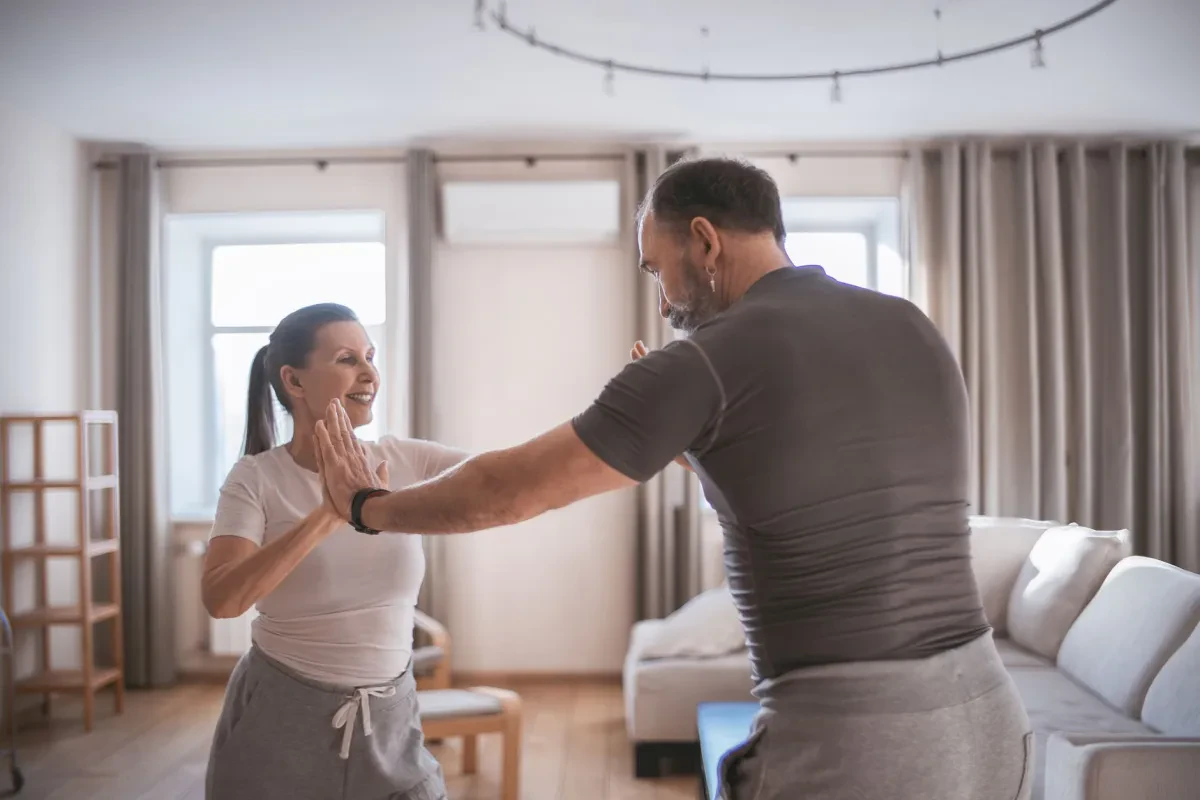
Dual-task training works the brain and body at the same time: find out why, after the age of 50, it's one of the most effective tools for preventing falls and staying independent in everyday life.
You don't fall when you're standing still: you fall when you're distracted
Think about the last time you tripped. You were probably walking and, at the same time, replying to a message, carrying groceries, or talking to someone. That's no coincidence: falls in everyday life rarely happen when your attention is focused on balance. They almost always happen when the brain is busy doing something else.
It's from this simple — yet often overlooked — observation that dual-task training was born: a training method that asks you to simultaneously perform a motor task and a cognitive one. Walking and counting. Standing on one leg and thinking. Moving and deciding, all at once.
What dual-task training actually is
Dual-task training requires the simultaneous execution of two tasks: one physical (motor) and one mental (cognitive). These aren't complicated exercises, but purposeful pairings that recreate the real conditions of everyday life. Some concrete examples:
- Walking while counting backwards from 100 in sevens — every step counts, and so does every number.
- Balancing on one leg while listing animals beginning with the letter B — the brain is occupied, the body must compensate on its own.
- Multi-directional steps following random verbal instructions while naming items from a semantic category.
- Tandem walking while reciting the alphabet backwards — a classic, and surprisingly difficult.
The goal isn't to make the exercise harder. It's to train the nervous system to handle interference — exactly the kind that real life throws at us every day.
Why it becomes essential after 50
With age, certain physical and cognitive abilities tend to decline in parallel: balance, reaction speed, coordination. The problem isn't that they decline separately — it's that they decline in interaction with each other. When the brain is under cognitive pressure, balance deteriorates disproportionately compared to younger individuals.
Fall prevention in people over 50 is one of the few areas where physical intervention has a very favourable cost-to-benefit ratio: acting before a fall occurs — and the potential fracture, head trauma or loss of independence that may follow — is infinitely more effective than intervening afterwards. Dual-task training fits precisely into this space: it requires no costly equipment, is adaptable to every starting level, and can be begun safely with simplified variations.
Practical note: for beginners, it's always advisable to start on stable surfaces and, if necessary, with a support nearby. Progression is the key.
More than prevention: an athlete's mindset
If you're a runner, a cyclist, or have ever taken part in a race — even an amateur one — you already know what we're talking about. During a race, an athlete isn't just managing physical effort: they're making decisions, adjusting pace, reading the course, all at the same time. Dual-task training isn't a practice for "frail older people": it's a skill that every active person should develop, because it's exactly the structure of movement in real life.
This is the kind of training that Strongers embraces within its Prevention pillar: not isolated gym exercises, but practices that translate health into concrete, measurable, everyday autonomy.
Where to start today
You don't need a gym. Ten minutes, a clear space, and a little cognitive courage are all it takes. Try this basic sequence:
- Walk for 2 minutes counting backwards from 50 to 1 (repeat if you finish).
- Stop, stand on one leg for 20 seconds while mentally listing Italian cities.
- Resume walking, calling out a different animal every three steps.
It sounds like a game. In reality, it's one of the most complete workouts you can do — and your brain will thank you just as much as your muscles will.