
Patellar Tendinopathy: How to Prevent and Manage It as a Charity Athlete
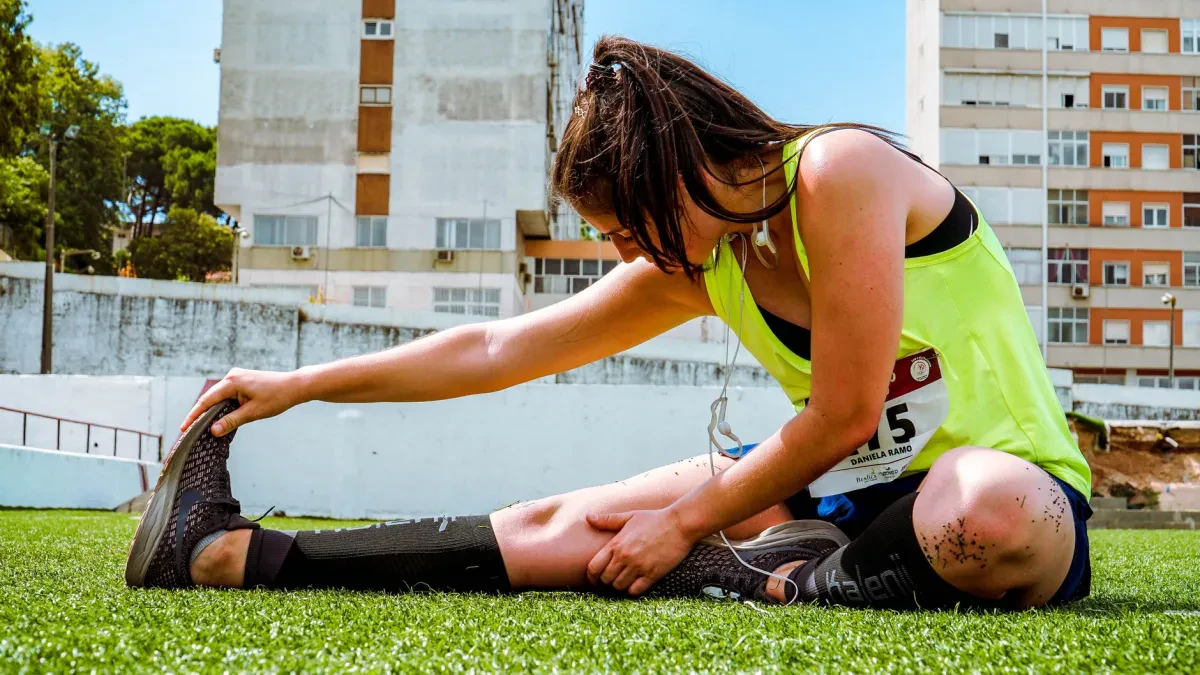
That sharp, pinpoint pain just below the kneecap during jumps and landings is called patellar tendinopathy. Learn how to recognise it, the 4-stage recovery protocol, and how to prevent it if you're a Spartan Race athlete or marathon runner.
That pain below the knee is not in your head: recognise it before it stops your race
You're training for a Spartan Race, a downhill marathon or a workout packed with jumps and obstacles. At some point, a precise, pinpoint pain appears directly below the kneecap. You feel a sharp twinge during a jump or landing — it may ease off after the warm-up, but it comes back. This could be the sign of patellar tendinopathy, also known as Jumper's Knee.
Don't ignore it. It's not the same discomfort as Runner's Knee (patellofemoral pain syndrome), and it's important to tell them apart: patellar tendinopathy affects the patellar tendon, the fibrous connective structure that links the kneecap to the tibia. Athletes who run on flat surfaces regularly are at lower risk, but those who load the knee explosively — jumps, landings, accelerations, steep descents — fall into a high-incidence category.
Who is really at risk among Strongers athletes
If you compete in Spartan Race or obstacle disciplines, the loading profile you face — jumps, drops, climbing — is precisely what exposes the patellar tendon to repetitive stress. The same applies to marathon runners over 50 who include downhill sections in their training plan: the eccentric load on the patellar tendon during downhill running is significant and, if accumulated week after week without gradual progression, becomes a concrete risk factor.
Warning signs not to underestimate:
- Sharp infrapatellar pain during jumps, landings, deep squats or descents
- Pain that worsens with accumulated load week after week
- Localised discomfort directly on the patellar tendon, distinct from the anterior/diffuse pain of patellofemoral syndrome
The 4-stage protocol: returning to competition safely
Rehabilitation from patellar tendinopathy is not an improvised process. The most widely used evidence-based framework involves 4 progressive stages, each with precise objectives, benchmarks and advancement criteria — an approach that respects the tendon's biological timeline without leaving the athlete in a limbo of indefinite inactivity.
- Stage 1 — Acute pain management and reduction of irritating load. The goal is not complete immobility, but eliminating the movements that keep irritation high.
- Stage 2 — Isometric loading and initial muscle strengthening, to restore neuromuscular function without overloading the tendon.
- Stage 3 — Progressive eccentric and isotonic exercises (including the single-leg decline squat, a key tool both for diagnostic testing and rehabilitation), with attention to the full kinetic chain.
- Stage 4 — Return-to-sport: gradual reintroduction of sport-specific movements (jumps, landings, accelerations) with monitoring of pain the day after each session.
One practical criterion to always keep in mind: the next-day pain test. If the morning after a session the tendon pain has increased compared to baseline, the load was too high. This is not a failure — it's the feedback your tendon is giving you. Listen to it.
Prevention: the levers you can act on today
The primary cause of patellar tendinopathy is a rapid, non-progressive increase in training volume, intensity or frequency. Sound preventive practices are straightforward to understand, less straightforward to follow when motivation is high and race day is approaching:
- Increase your weekly load gradually and in a monitored way, avoiding sudden spikes
- Don't neglect eccentric strengthening of the quadriceps, especially if you include downhill work in your plan
- Build in genuine recovery days between high-impact sessions
- Learn to distinguish muscle fatigue pain from tendon pain: the localisation and response to load are different
Training with intelligence, competing for something greater
At Strongers we know that the motivation to push beyond one's limits is one of the most powerful forces that exists — especially when that effort supports oncological research. But a charity athlete who is sidelined by a preventable injury cannot run, ride or climb the next challenge. Taking care of your patellar tendon means taking care of your capacity to do good.
If you have any concerns about your knee, speak with a trusted physiotherapist before pushing harder. The protocol exists, it works — and return-to-sport is a realistic goal if rehabilitation is approached with the same discipline you bring to your training.